
There is one ingredient that has become increasingly important for successful strategic change with the growth of AI: involving people in the change journey.
I’ve led many transformations over the years, and this one principle has proven timeless: talk to the people who do the work: early, openly, and often. In the AI era, this is not a courtesy. It’s the foundation for strategy execution that actually works in practice.
AI has multiplied the pace and complexity of change. It’s also expanded what leaders can’t see. The higher up you go, the smaller your field of vision becomes. CEOs often tell me they feel isolated. Many find it hard to get unbiased information from their people.
The Iceberg of Ignorance still shapes our organizations
In 1989, Sidney Yoshida introduced a concept called the Iceberg of Ignorance. He found that:
- Senior leaders are aware of only 4% of their organization’s problems.
- Middle managers know about 9%.
- Supervisors see 74%.
- Frontline workers understand almost 100%.

That was 35 years ago. Today, I observed that the “underwater” portion of the iceberg is even larger. Hybrid work, digital processes, and AI experimentation have created layers of activity invisible to those at the top.
McKinsey’s Superagency Report 2025 finds employees are already experimenting with generative AI three times more often than their leaders realise. This shows that frontline innovation is happening, but not strategically orchestrated nor with the full understanding of the leadership.
All of this disconnectedness between executives and staff has the potential to get worse as skills are being disrupted like never before. According to the World Economic Forum’s 2024 Future of Jobs Report, 43% of workforce skills will change or erode within five years. When the world is shifting that quickly, blind spots become liabilities.
The implication for change leaders is the need to surface what sits below the waterline in order to add value and orchestrate aligned strategic change.
Culture intelligence: using culture as strategic insight
When I design strategy execution or transformation programs, I begin by prioritizing culture intelligence. It means using your existing culture as data: to understand how things really get done before figuring out what needs to change, and how to deliver change support.
If you are working on strategy or organizational change, you have heard and seen this before: many strategies sound brilliant in the boardroom but fail on the ground. Not because the ideas are wrong, but because they ignore culture. Culture isn’t the last thing to address after signing off on a plan. It’s the starting point for execution.
Here’s what a culture-intelligent approach looks like:
- Use current culture to shape how you develop your strategy.
- Use current culture to inform your change plan and communication rhythm.
- Use current culture to design how projects are governed and decisions are made.
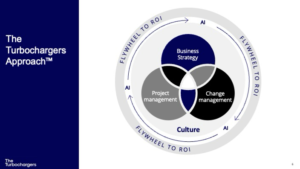
When you start from how people actually work, you move from pushing change to creating pull. People see themselves in the journey, which builds momentum.
Listening below the waterline
When I help organizations launch transformation programs, especially AI-enabled ones, we set up governance that involves a way to include the voice of people.
That means cross-functional working groups that run through the entire project. These aren’t one-off focus groups. They’re live governance forums where people at all levels contribute to design decisions.
Each group brings together three perspectives that are equally essential:
- Business strategy and subject-matter experts who understand the commercial and operational context.
- Change and culture specialists who sense resistance, motivation, and learning needs.
- Project and delivery leaders who turn insights into practical workflow redesign.
This structure makes governance meaningful. It’s not bureaucracy, it’s participation with purpose. Governance becomes how we institutionalise listening and make sure decisions are informed by reality, not assumptions. This information is shared across different levels of the organization. This is again baked into the governance structure and operating rhythm of the program.
McKinsey’s 2025 research supports this. organizations where CEOs and boards actively oversee AI governance achieve better financial outcomes. Oversight isn’t red tape: it’s clarity on who decides what, and how the human voice is represented in AI-driven change.
From fear to trust: a story of transformation
A few years ago, I worked with a client whose culture was steeped in fear. Employees were terrified of making mistakes. Performance issues weren’t surfaced; they were buried.
We began by creating safe spaces for honest conversation. We held discussions with frontline staff, guaranteeing confidentiality. We then shared themes with supervisors, and asked for their perspective. The process continued up each level of management until the findings reached the board.
This wasn’t a one-time consultation; it was a cascade of listening that built psychological safety layer by layer.
The impact was profound. The organization changed its approach to errors, focusing on learning rather than blame. We simplified processes, and introduced new practices to support teamwork.
At the end of the project, a blue-collar worker told me, “I used to be scared to come to work. Now my team has my back.”
That moment captured the transformation. Productivity rose by around 20%, and behavioural measures showed statistically significant improvements. Using the Kirkpatrick model of learning, we saw immediate reactions, sustained behaviour change, and measurable performance impact.
Fear was replaced with trust, and the business thrived. Irrespective of your culture’s starting point: whether it is scattered AI innovation that you want to encourage, or whether you’re faced with a fear-based staff: you need to build in a way to listen “below the waterline” of Yoshida’s iceberg.
What change leaders can do now
If you lead change or transformation, especially with AI in the mix, here’s where to focus:
- Start with culture intelligence.
Diagnose how work really gets done. Use culture as data to shape your approach before finalising your plan. - Build your listening architecture early.
Create cross-functional groups that bring the frontline voice into design and delivery from the start. - Redesign at least one workflow fast.
Pick a core process and co-design it with those who do the work. McKinsey (2025) found that workflow redesign is the number-one predictor of AI value creation. - Treat governance as a change tool.
Define decision rights, feedback loops, and escalation paths that keep listening alive throughout the project. - Invest in learning and transparency.
Involve employees in shaping the change. The World Economic Forum warns that almost half of today’s skills will be outdated within five years. Helping people learn and experiment inside the change reduces fear and speeds adoption. It offers something for everyone by being involved in the change. And it is particularly relevant where there is the fear or possibility that jobs may disappear or significantly be altered via an organizational redesign.
Seeing below the surface
The Iceberg of Ignorance reminds us that most of what matters is hidden below the surface. AI has made the unseen portion even larger.
But by applying culture intelligence, building participation into your governance, and encouraging upskilling throughout your AI transformation, we can melt the iceberg, one conversation at a time.
When we start with people, we end with progress.
Sources
-
- Yoshida, S. (1989). The Iceberg of Ignorance : commonly cited summary from multiple management analyses.
- McKinsey & Company (2025). Superagency in the workplace: Empowering people to unlock AI’s full potential
- McKinsey & Company (2025). Reconfiguring Work: Change Management in the Age of Gen AI.
- World Economic Forum (2024). The Future of Jobs Report.
- Mollick, E. (2024). Orchestration, Not Command: Leadership in the AI Era. Wharton School.
- Harvard Business Review (2023). In Praise of the Incomplete Leader and Cultural Intelligence.
- Edmondson, A. (2019). The Fearless Organization. (Harvard Business Review Press).
- Kirkpatrick, D. L., & Kirkpatrick, J. D. (2006). Evaluating Training Programs: The Four Levels.
- Fitzpatrick, J. L. et al. (2011). Program Evaluation: Alternative Approaches and Practical Guidelines.
About the author
 Lisa Carlin is a Strategy Execution Specialist, Founder of The Turbochargers. She works with business leaders to go from strategy to plan to result with culture intelligence and AI. Lisa’s career includes roles at McKinsey and Accenture, then running her own business since 1999. Over this time she has delivered over 50 implementations with a 96% success rate. For more, join 8,000 business leaders who subscribe to Lisa’s globally acclaimed newsletter, Turbocharge Weekly.
Visit Lisa’s community, resource hub and online academy, The Turbochargers Hub where strategy, projects and change meet: powered by culture-intelligence and AI. Connect with Lisa on LinkedIn.